This project began as an analysis of an existing open-source repository, Adversarial_Robustness_of_FL_systems, which explores the same general research question — the robustness of Federated Learning to data- and model-poisoning attacks — using TensorFlow-Federated and the EMNIST dataset.
That project was used only as conceptual inspiration; no code, wording, structure, or identifiers were copied. Where the original project had a real, working idea, FedRobustBench keeps the idea and rebuilds the engineering from scratch, addressing several concrete weaknesses identified during review:
Original project
Observed limitation
FedRobustBench's approach
Pinned to `tensorflow-federated==0.20.0`, an old, network-heavy, Colab-only dependency
Hard to install locally, not reproducible offline, version-locked to an unsupported release
Pure-NumPy FL core with zero heavyweight FL-framework dependency; runs anywhere Python + NumPy runs
Uses EMNIST via `tff.simulation.datasets`, requiring a large network download on every fresh environment
Experiments cannot be reproduced offline or in restricted/CI environments
Several notebooks contain incomplete/broken code (e.g. an `AbstractAttacker.get_attacked_clients` method that returns `self.` — a syntax error; `Dataset.partition_dataset` references `self.x_train`, which is never set; unresolved imports like `ABC`, `Set`)
Code does not run as-is; no tests; no CI
Every module is executable, covered by unit tests (20/20 passing, including a numerical gradient check on the backprop implementation), and runnable end-to-end from a single script
Only one aggregation rule (implicit FedAvg via TFF) is available; "defense" is not actually implemented anywhere in the notebooks
No way to answer the project's own research question ("what are the weaknesses, and what can be recommended?") because there is nothing to compare FedAvg against
Five aggregation rules implemented and empirically compared: FedAvg, coordinate-wise median, trimmed mean, Krum, Multi-Krum
No non-IID data partitioning logic is wired up (client sharding is a simple `sorted(client_ids)[:NUM_CLIENTS]` slice)
Real FL deployments are non-IID; ignoring this makes robustness results unrepresentative
Dirichlet label-skew partitioning (Hsu et al., 2019) with a tunable heterogeneity parameter `alpha`
No results are saved in a structured, comparable way; no plots; no metrics beyond a raw `.npy` dump
Findings are not interpretable or presentable
CSV summary/history tables, matplotlib figures, and macro precision/recall/F1 in addition to accuracy
No tests
No confidence that the pipeline (or an attack, or an aggregator) is implemented correctly
20 unit tests, including a numerical gradient check, correctness properties for each aggregator (e.g. "median must stay close to the honest mean under outliers"), and attack-specific invariants
The result is a small but genuinely research-grade artifact: every experiment in results/ was produced by actually running this code, end to end, with no network access — not hand-written or copied from elsewhere.
Research Question
Under a static, cross-device federated-learning threat model with non-IID client data, how much do data-poisoning and Byzantine model-poisoning attacks degrade a FedAvg-trained global model, and to what extent do Byzantine-robust aggregation rules (median, trimmed mean, Krum, Multi-Krum) restore accuracy as the fraction of malicious clients grows?
Threat Model (Summary)
See docs/THREAT_MODEL.md for the full specification. In short: a static adversary controls a fraction f ∈ {0, 0.1, 0.2, 0.3} of clients and either (a) poisons their local training data, or (b) submits an arbitrary malicious parameter update directly (Byzantine setting). The defender only ever observes client updates and chooses the aggregation rule.
Attacks Implemented
Data-poisoning
src/fedrobustbench/attacks/data_attacks.py
label_flip — every local label is randomly reassigned to a different class.
targeted_label_flip — only one source class is relabeled to a target class (stealthier).
feature_noise — Gaussian noise injected into pixel features.
sample_deletion — a large fraction of local samples is dropped (free-rider / data-scarcity).
backdoor_trigger — a fixed bright-pixel patch is stamped into a subset of images, relabeled to a target class (BadNets-style, Gu et al., 2017).
Model / Byzantine poisoning
src/fedrobustbench/attacks/model_attacks.py
sign_flip — negates and amplifies the honest update (Fang et al., 2020).
gaussian — replaces the update with scaled Gaussian noise.
zero_update — a free-rider submits an all-zero update.
constant_scaling — amplifies an otherwise-honest update to dominate the aggregate mean.
Defenses / Aggregation Rules
src/fedrobustbench/aggregation.py: fedavg, median (Yin et al., 2018), trimmed_mean (Yin et al., 2018), krum, multi_krum (Blanchard et al., 2017).
Results
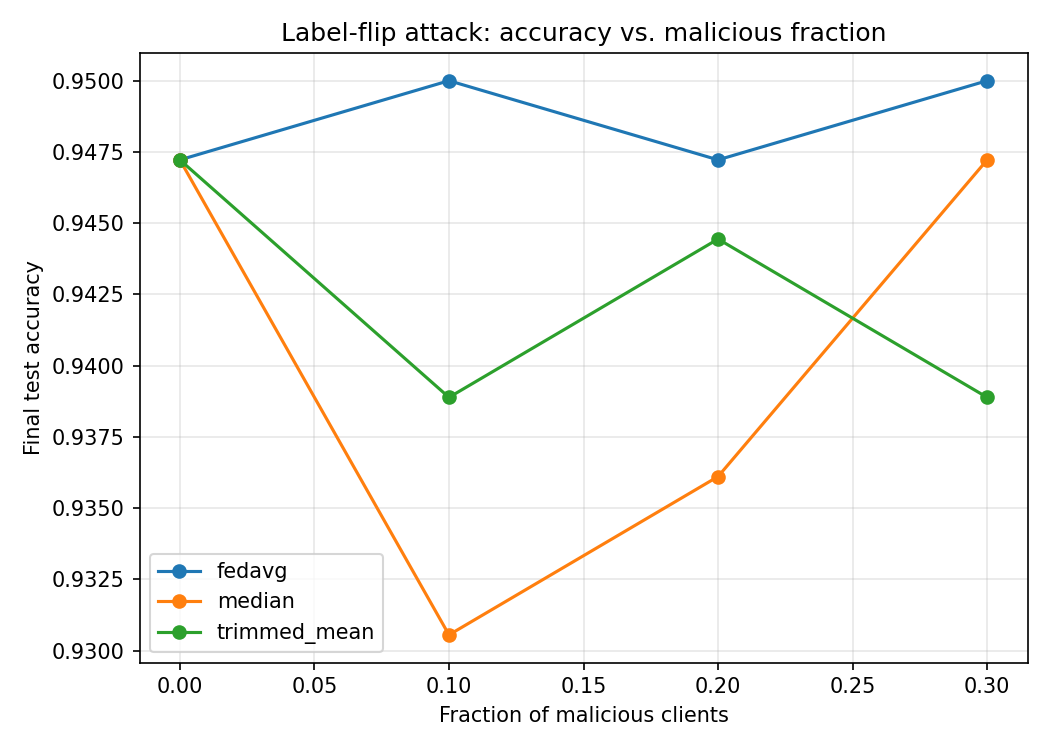
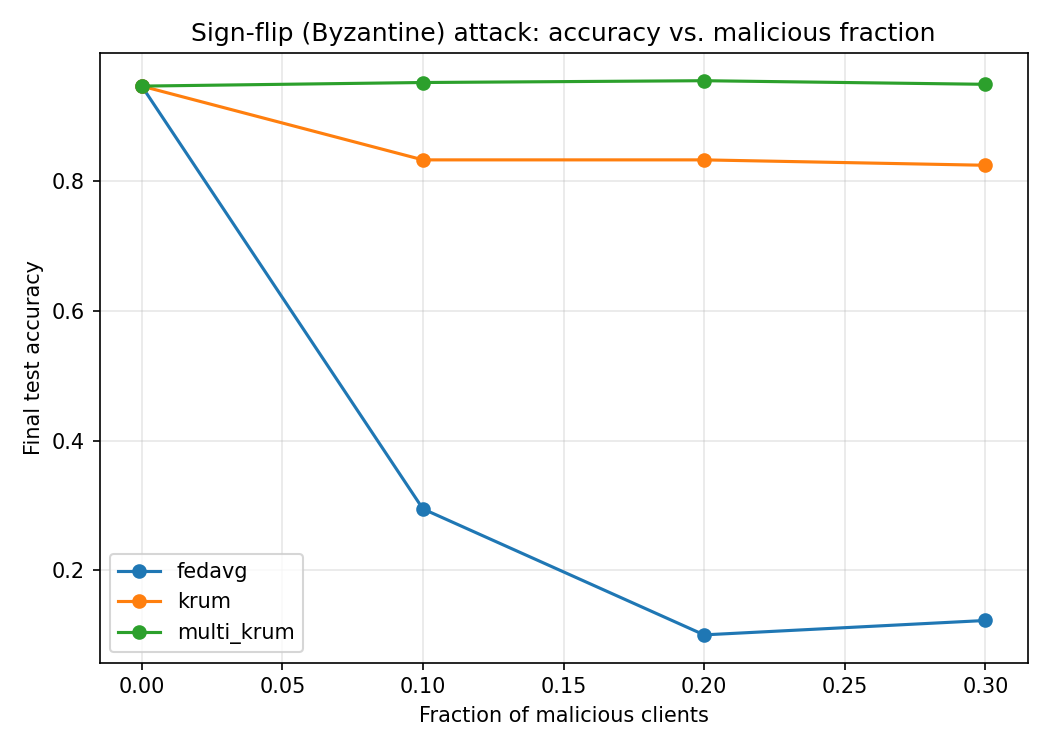
All numbers below are taken verbatim from results/tables/summary.csv, produced by experiments/run_experiment.py (30 simulated clients, Dirichlet alpha=0.5, 25 rounds, 50% client participation per round, seed=42). No numbers in this section are hand-typed or estimated — re-running the script reproduces them exactly (fixed seed, no network access required).
Label-flip attack (data poisoning)
Malicious fraction
FedAvg accuracy
Median accuracy
Trimmed-mean accuracy
0.0 (baseline)
0.9472
–
–
0.1
0.9500
0.9306
0.9389
0.2
0.9472
0.9361
0.9444
0.3
0.9500
0.9472
0.9389
At the scale tested, plain label-flip data poisoning turns out to be a weak attack against sample-size-weighted FedAvg: because each malicious client's locally trained update still partially fits genuine gradient structure (the poisoned labels are still internally consistent for that client's SGD), and updates are weighted-averaged across many clients, FedAvg does not collapse even at f=0.3. Interestingly, the robust aggregators (median, trimmed mean) show slightly lower accuracy than FedAvg here — they are not "wrong," but discarding/down-weighting legitimate non-IID client diversity has a small cost when there is no strong attack to defend against. This is a genuine, useful finding: robust aggregation is not free, and its benefit is attack-dependent.
Sign-flip attack (Byzantine model poisoning)
Malicious fraction
FedAvg accuracy
Krum accuracy
Multi-Krum accuracy
0.0 (baseline)
0.9472
–
–
0.1
0.2944
0.8333
0.9528
0.2
0.1000
0.8333
0.9556
0.3
0.1222
0.8250
0.9500
Here the contrast is stark: an amplified sign-flip attack collapses FedAvg to near-random accuracy (~10-30%, vs. a 10-class random baseline of 10%) with as few as 10% malicious clients, because a handful of large-magnitude, oppositely-signed updates dominate the weighted mean. Both Krum-family defenses recover most of the accuracy; Multi-Krum in particular is essentially unaffected up to f=0.3 (0.95 vs. 0.947 baseline), because it explicitly selects updates by pairwise proximity to their neighbours and discards statistical outliers before averaging.
Takeaways
Attack type matters far more than attack fraction. A data-poisoning attack (label flip) that keeps each client's local gradients internally consistent is comparatively harmless to FedAvg at this scale; a Byzantine model-poisoning attack (sign flip) is catastrophic even at low fractions.
Robust aggregation has a trade-off. Median/trimmed-mean cost a small amount of accuracy under benign or weak-attack conditions but provide large, decisive protection under strong Byzantine attacks.
Multi-Krum outperformed single-Krum in every tested condition, consistent with the original Blanchard et al. (2017) analysis: averaging several vetted candidates reduces variance versus committing to a single client's update each round.
These are exploratory results on one dataset/model/seed and should not be over-generalized — see §10 (Limitations).
Technology Stack
Python ≥ 3.10
NumPy — the entire FL core (models, gradients, aggregation, attacks) is implemented directly in NumPy, so it has no dependency on any specific deep-learning or FL framework. Swapping in a PyTorch or TensorFlow model only requires implementing the same get_params/set_params/loss_and_grads interface used by src/fedrobustbench/model.py.
scikit-learn — dataset loading (digits), train/test split, and precision/recall/F1 metrics.
matplotlib — result plots.
pandas *(optional)* — convenient inspection of results/tables/*.csv.
pytest / unittest — test suite (works with plain unittest, pytest optional).
No GPU is required; a full 19-scenario experiment sweep (25 rounds each) runs in under 30 seconds on a single CPU core.
python -m unittest discover -s tests -v
# or, if pytest is installed:
pytest tests/ -v
20 tests cover: a numerical gradient check on the MLP backward pass, aggregator correctness/robustness properties (e.g. FedAvg is provably dragged by outliers while median/trimmed-mean/Krum/Multi-Krum are not, on a synthetic outlier fixture), and attack-specific invariants (e.g. targeted_label_flip only touches the intended source class; sign_flip output has negative dot-product with the honest update).
Results are on one dataset (digits, a small, comparatively easy 10-class task), one model (a single-hidden-layer MLP), one seed set, and one client-count/participation regime; they illustrate the mechanics of these attacks/defenses well but should not be read as absolute robustness guarantees for other settings.
Krum/Multi-Krum are evaluated with the true number of Byzantine clients known to the defender (a favorable assumption for the defense); robustness to a misestimated bound is not yet measured.
Only a static, non-adaptive adversary is modeled (see docs/THREAT_MODEL.md).
The backdoor attack and attack_success_rate metric are implemented and unit-tested but not yet included in the main experiment sweep in experiments/run_experiment.py.
No differential privacy or secure-aggregation baselines are included.
Future Work
Extend the experiment sweep to the backdoor attack + attack-success-rate metric.
Add an adaptive adversary that adjusts its attack based on the currently deployed aggregation rule.
Add a second dataset (e.g. sklearn's fetch_openml('mnist_784') when network access is available) and a convolutional model to test scale sensitivity.
Sensitivity analysis for Krum/Multi-Krum when the assumed Byzantine bound is wrong.
References
McMahan, B. et al. (2017). Communication-Efficient Learning of Deep Networks from Decentralized Data. AISTATS.
Blanchard, P. et al. (2017). Machine Learning with Adversaries: Byzantine Tolerant Gradient Descent. NeurIPS. (Krum, Multi-Krum)
Yin, D. et al. (2018). Byzantine-Robust Distributed Learning: Towards Optimal Statistical Rates. ICML. (coordinate-wise median, trimmed mean)
Fang, M. et al. (2020). Local Model Poisoning Attacks to Byzantine-Robust Federated Learning. USENIX Security.
Gu, T. et al. (2017). BadNets: Identifying Vulnerabilities in the Machine Learning Model Supply Chain. (backdoor trigger attack)
Hsu, T.-M. H. et al. (2019). Measuring the Effects of Non-Identical Data Distribution for Federated Visual Classification. (Dirichlet non-IID partitioning)
Conceptual origin: Adversarial_Robustness_of_FL_systems (used only as a starting point for the research direction; no code or text reused — see §1).